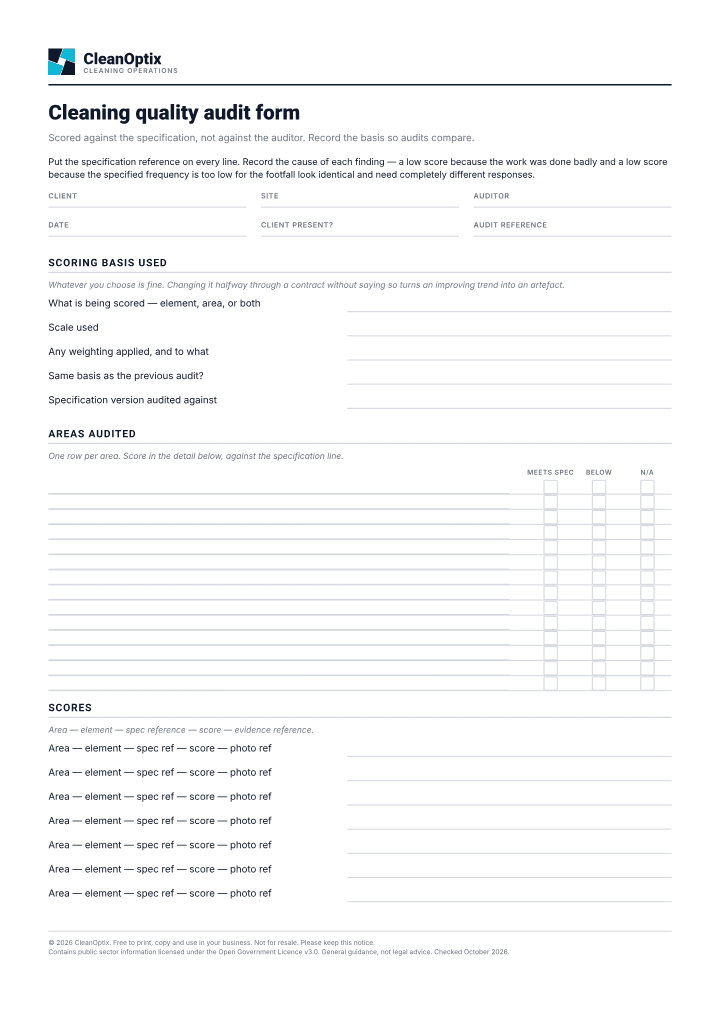
Cleaning quality audit form. A printable quality audit — area by area, scored against the specification rather than against an opinion, with findings that have an owner and a date.
This is the paper version. CleanOptix does the same job on a phone, with the record filed against the site and the cleaner automatically.
What is on the sheet
- Site, areas audited, auditor, date and whether the client was present
- A row per area and element, scored against what the specification actually says
- A scoring basis recorded on the sheet, so successive audits compare
- Photographic evidence references, rather than photographs pasted into a form
- Findings with a cause — standard, frequency, access, staffing or equipment
- Actions with an owner and a date, and a re-audit block that closes the loop
Why this record matters
An audit score is only meaningful if it is scored against something fixed, and most cleaning audits are scored against the auditor. The same corridor scores differently for two supervisors, and the client notices long before anybody admits it — which is why the specification reference is on every line of this sheet.
Recording the scoring basis on the form is what makes a run of audits comparable. Whether you score by element, by area, or weight the washrooms is entirely your decision; changing it halfway through a contract without saying so turns an improving trend into an artefact.
The cause column is the one that makes audits useful rather than punitive. A low score because the cleaner did it badly and a low score because the frequency in the specification is too low for the footfall look identical on a scoresheet and need completely different responses — and only one of them is the cleaner's fault.
The re-audit block exists because an audit without one is a complaint with a number on it. Closing a finding means going back and looking, and a form that has nowhere to record that has recorded half a process.
Use it with
- Cleaning specification templateA printable cleaning specification — area by area, what is cleaned, to what standard, how often and who is responsible for the things nobody ever agrees.
- Cleaning task checklistA printable task checklist for a shift — the areas and tasks due, ticked as they are done, with room for what could not be done and why.
- Client issue and complaint recordA printable record for a client complaint or issue — what was raised, what was found, what was done, and whether it was the clean or the contract that was wrong.
- Cleaning schedule templateA printable cleaning schedule — who is on which site, when, covering what, and what happens when somebody does not turn up.
Read more on this
© 2026 CleanOptix. Free to print, copy and use in your business. Not for resale. Please keep this notice.
Contains public sector information licensed under the Open Government Licence v3.0. General guidance, not legal advice. Checked October 2026.